You pick a region per service. It shows up in one of two places: the base URL you
call, or the region you set when you create an agent. See the
regions map for every region and its base URL.
Latency. Pick the region closest to your callers. Region sets the latency
floor for every turn, and a distant region adds hundreds of milliseconds to each
round trip.
Data residency. If a jurisdiction requires your data to stay inside its
borders, pick that region instead.
Requests are not routed between regions, so use the same region for speech to
text and text to speech in one turn.
The region is in the base URL. Call the regional host instead of api.slng.ai.
For example, send the request to eu-west.api.slng.ai to run it in that region.
The path and body stay the same.
Speech to text uses the same host with the /v1/stt/... path. You can use any
model available in that region. See the regions map
for every region’s base URL.
The region is part of the Context Router base URL. Use the regional endpoint in your OpenAI-compatible client or agent integration. See the regions map and Context Router API reference for the available server URLs and Custom LLM for the integration setup.
An agent does not take a base URL. You set its region once, when you create the
agent, and it stays there. The region also decides which models the agent can use:
only the models available in that region show up.
Dashboard
API
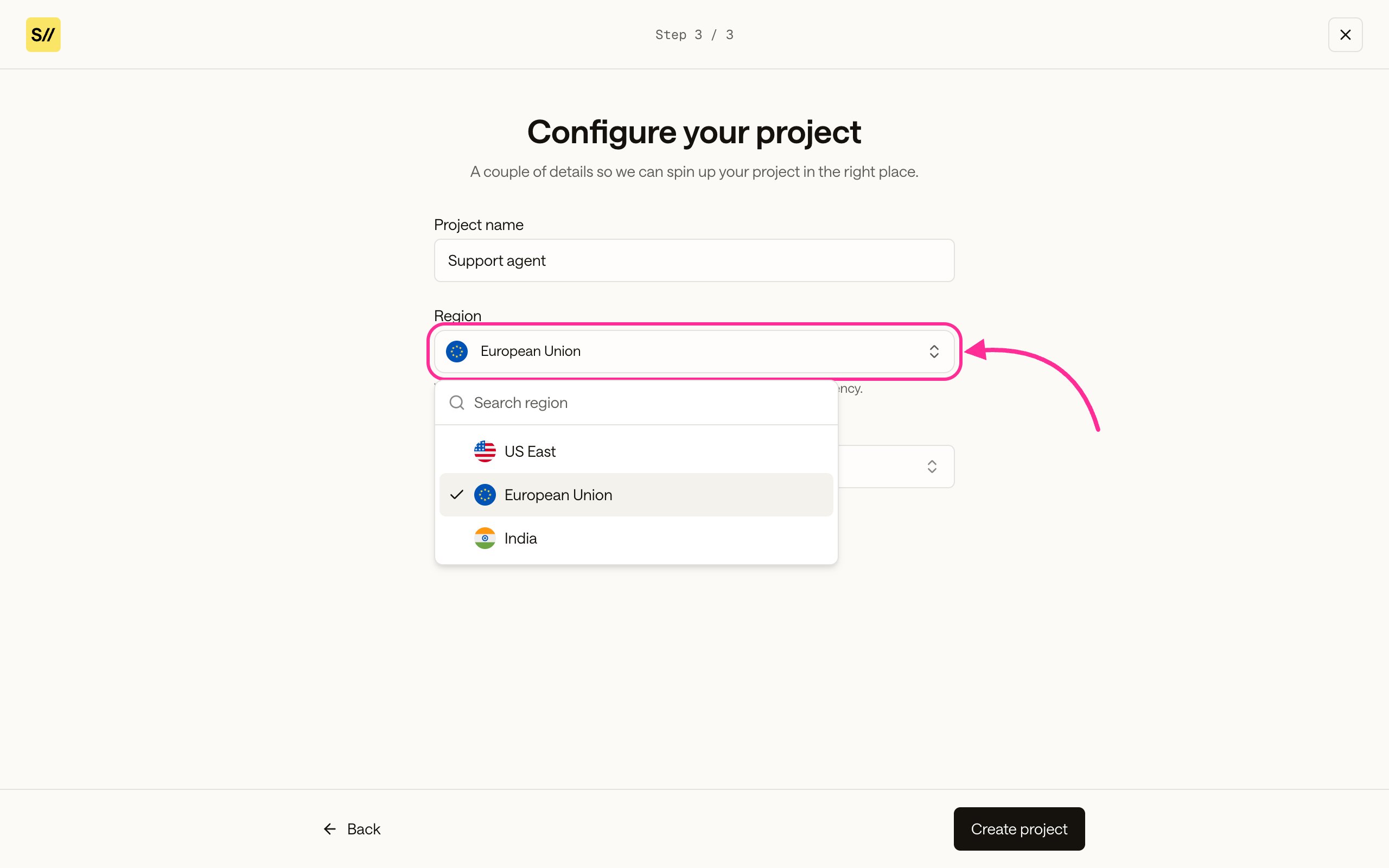
On the Configure your project step, open the Region dropdown and pick a
region.
The region selector on the Configure your project step.
Set the region field in the create body. See the
regions map for the values you can use.
{ "name": "Support agent", "region": "eu-central", "language": "en", "system_prompt": "You are a support agent for Wayne Enterprises.", "greeting": "Hi, how can I help you today?", "models": { "stt": "deepgram/nova:3", "llm": "bedrock-mantle/nvidia.nemotron-super-3-120b:latest", "tts": "slng/fish/tts:s2.1-pro", "tts_voice": "16cabdb7f8d240569aff36c9e480d783" }}
Default to the region closest to your users. Latency is the biggest lever you
have on a live call. Switch to a specific region only when data residency
requires it. Whichever you pick, use it across every service so a turn stays in
one place.